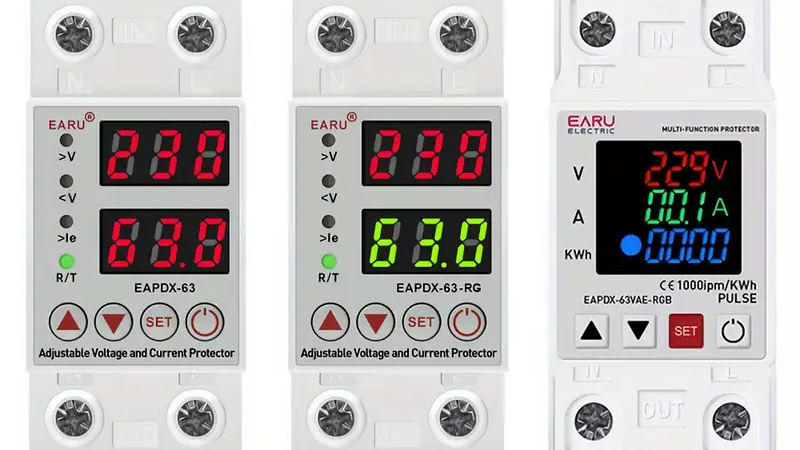
An Over/Under Voltage Protection Relay is a sophisticated monitoring and control device that continuously measures the voltage of a power supply. Its sole purpose is to automatically disconnect electrical equipment from the power source if the voltage drifts outside a safe, pre-set range (either too high or too low). It reconnects the power only when the voltage returns to a normal level for a stable period.
Think of it as a highly intelligent, programmable guardian for your electrical systems.
The Problem: Why Both Over AND Under Voltage are Bad
While overvoltage is an obvious threat, undervoltage (also known as a “brownout”) is equally dangerous but in a different way.
| Condition | Causes | Consequences on Equipment |
|---|---|---|
| Overvoltage | Lightning strikes, grid switching errors, lost neutral wire, large loads turning off. | Instantaneous Damage: Insulation breakdown, overheating, component failure (melting, explosion). Cumulative Damage: Degrades components over time, reducing lifespan. |
| Undervoltage | Grid overload (e.g., heatwaves), faulty transformers, starting of very large motors, long undersized cables. | Overheating: Motors draw more current to maintain power (P = V x A). This excessive current causes overheating and burnout. Malfunction: Electronics and controls may reset, behave erratically, or fail to operate. |
An Over/Under Voltage Relay protects against both of these destructive conditions.
How the Relay Helps: The Step-by-Step Process
This relay is more than just a simple switch; it’s a logic-based controller. Here’s how it operates:
- Continuous Monitoring: The relay is constantly measuring the incoming line voltage (either single-phase or three-phase) via its sensing inputs.
- Comparison to Setpoints: An internal microprocessor compares the measured voltage to its user-defined settings:
- Overvoltage Pickup (Trip): The upper voltage limit (e.g., 110% of nominal).
- Undervoltage Pickup (Trip): The lower voltage limit (e.g., 90% of nominal).
- Time Delays (Crucial Setting): The length of time the abnormal voltage must persist before the relay acts.
- Decision Making & Action:
- If the voltage exceeds the Overvoltage setpoint for longer than the time delay, the relay sends a signal to trip a circuit breaker or contactor, disconnecting the load.
- If the voltage falls below the Undervoltage setpoint for longer than the time delay, the relay does the same thing: it trips the breaker to disconnect the load.
- Automatic or Manual Reset:
- The relay continues to monitor the voltage after a trip.
- Once the voltage returns to within the normal range and remains stable for a pre-set “reset time delay,” the relay will automatically (or manually, depending on configuration) close the breaker again, restoring power.
Key Features and Settings That Make It Effective
- Adjustable Setpoints: Allows engineers to tailor the protection to the specific needs of the protected equipment (e.g., a sensitive CNC machine vs. a pump motor).
- Time Delays (Timers): This is the relay’s intelligence. It prevents nuisance tripping caused by harmless, brief voltage fluctuations that always happen on a real-world power grid (e.g., when a nearby air conditioner starts).
- Visual Indicators & Communication: They have LED indicators for status (Normal, Tripped on Over, Tripped on Under) and often communication ports (like Modbus) to send alarms and data to a central control system.
Where It Is Used & How It Helps
| Application | How the Relay Helps |
|---|---|
| Industrial Motor Protection | Prevents motor burnout. It stops the motor from running during undervoltage, preventing it from drawing excessive current and overheating. It also protects against insulation damage from overvoltage. |
| HVAC Systems | Protects compressors and fan motors, which are expensive to repair and critical for climate control. |
| Generator & Mains Changeover | Monitors the quality of the utility mains power. If voltage is out of bounds, it signals the system to switch to a generator. It also protects the load from unstable generator output. |
| Data Centers & IT Infrastructure | Prevents servers and network hardware from crashing, malfunctioning, or suffering permanent damage due to poor power quality. |
| Home & Building Automation | Integrated into main distribution boards to protect the entire electrical installation of a building, safeguarding all appliances and preventing fire risks. |
Benefits Summary:
- Prevents Costly Equipment Damage: The primary benefit. Avoids the destruction of motors, compressors, controllers, and sensitive electronics.
- Eliminates Downtime: By preventing damage, it keeps production lines and critical systems running, saving thousands of dollars per hour in lost productivity.
- Reduces Fire Risk: Both overloads from undervoltage and insulation failure from overvoltage are potential fire starters. The relay mitigates this risk.
- Enhances System Reliability: Provides a stable and safe operating environment for all connected equipment, extending its operational lifespan.
In summary, an Over/Under Voltage Protection Relay is an essential component in modern electrical protection. It moves beyond simple surge suppression to provide intelligent, managed, and comprehensive protection against the wide spectrum of voltage-related problems that can occur on any power network.
So what can you use for your home that will not break the bank.
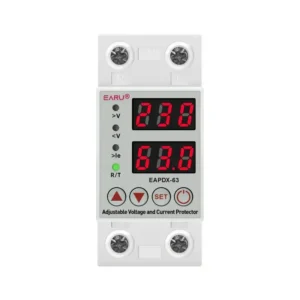
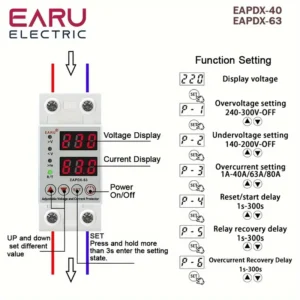
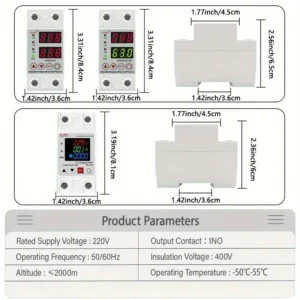
These devices will switch off immediately when an under/over voltage is detected and is not adjustable. I bought mine from Temu. The neutral wire passes straight through. The live wire passes through a relay. The wires used inside is thicker than the mains wires.
I have set mine at 300 seconds (5 minutes) to ensure that the electrical grid is stable, before my house gets power. This long duration also helps protect against power off, on, off, on as the electrical maintenance teams are busy testing and repairing.